AI image generator
Direct the scene your way. Create visuals with intentional angles, depth, and style
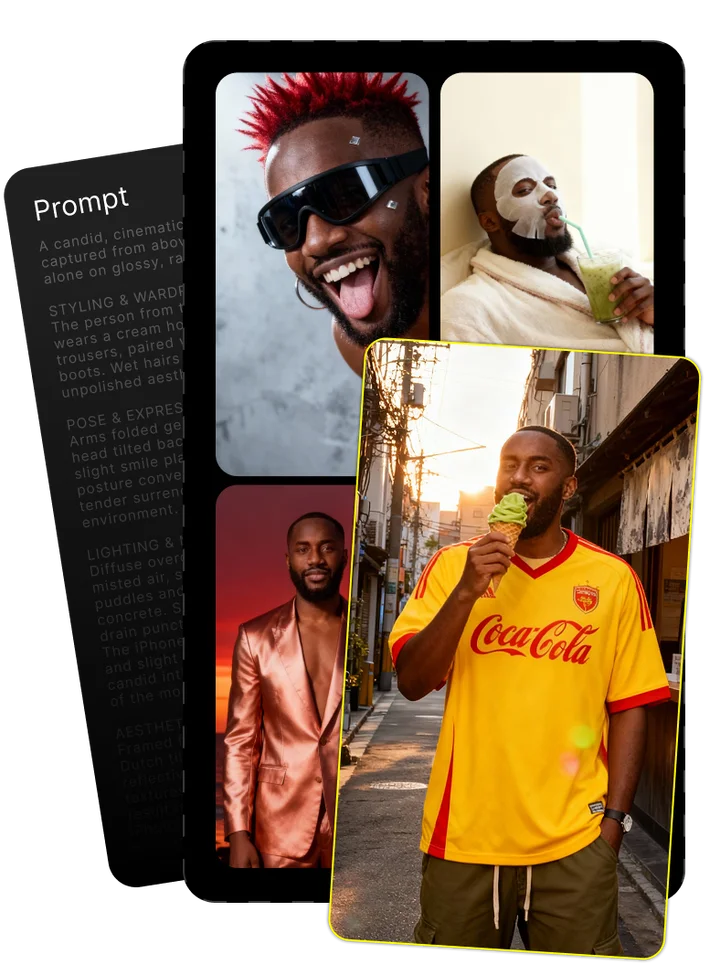
Upload your photo and tell us what you imagine
Combining both gives the best results

Enjoy your image brought to life by AI
Ideogram AI: Transforming Text-to-Image Generation for Modern Creators
Ideogram is rapidly establishing itself as a frontrunner in the AI image generation market, particularly notable for its exceptional text rendering capabilities. Unlike many competitors, Ideogram produces images with crisp, legible text—a critical advantage for creators working on marketing materials, social media content, and branded assets. This article offers a comprehensive overview of what makes Ideogram a powerful tool for today's content creators.
Key Takeaways
- Ideogram excels at text rendering within generated images, allowing for the creation of professional designs with readable text—a capability that sets it apart from most AI image generators.
- The platform is particularly effective for creating marketing materials, social media content, logos, and print-on-demand products, making it valuable for both businesses and independent creators.
- Ideogram offers both free and premium subscription plans, with advanced features like transparent backgrounds and batch processing available to paid subscribers.
- While accessible to beginners, Ideogram provides advanced editing capabilities that meet the needs of professional designers while requiring less technical expertise than traditional design software.
What Makes Ideogram Stand Out in the AI Image Generation Landscape
Ideogram has emerged as a significant player in the competitive AI image generation field, focusing on producing high-quality visuals with remarkably accurate text rendering. This emphasis on typography sets it apart in an industry where text has traditionally been a weakness for generative AI tools. Industry data shows growing demand for AI solutions that can reliably produce marketing materials and branded content—areas where text accuracy is non-negotiable.
When compared to leading platforms like Midjourney, DALL-E 3, and Stable Diffusion, Ideogram's standout feature becomes clear. While these competitors often struggle with text placement, readability, and spelling—often producing warped or nonsensical text—Ideogram consistently generates precise, legible typography that can be used directly in professional applications without extensive editing.
Beyond text rendering, Ideogram delivers professional design quality with a user interface that bridges the gap between powerful AI capabilities and practical usability. This balance makes it accessible to both seasoned designers looking to speed up their workflow and non-designers seeking professional-quality output without mastering complex software.
The Technology Behind Ideogram's Text Generation Mastery
Ideogram's exceptional text rendering stems from purpose-built AI models specifically trained to understand and reproduce typography elements. This specialized training enables the platform to generate images where text isn't merely an afterthought but a central, properly executed component.
Developed by a team of ex-Google engineers with expertise in machine learning and computer vision, Ideogram uses advanced AI models that process text differently than general image generators. While standard AI image models treat text as visual patterns rather than language, Ideogram's technology recognizes the semantic meaning of text and ensures it appears correctly in the final output.
The technical approach involves specialized training on typography datasets, enabling the AI to understand kerning, font styles, text placement, and readability principles. This level of specialization explains why Ideogram can maintain text consistency across varied designs while other platforms often produce garbled or misspelled results when text is requested.
Ideogram's History and Development
Ideogram was founded by a team of former Google engineers with extensive backgrounds in AI research. The founding team includes researchers from Google Brain, with academic connections to prestigious institutions like UC Berkeley, Carnegie Mellon University (CMU), and the University of Toronto—all recognized centers for artificial intelligence research.
This pedigree has significantly shaped Ideogram's development trajectory. The founders' experience with advanced machine learning models at Google provided the technical foundation for addressing one of the most persistent challenges in AI image generation: accurate text rendering. Their academic backgrounds at leading research institutions informed the rigorous approach to building specialized AI models focused on typography.
Since its inception, Ideogram has evolved through several major updates, each expanding capabilities while maintaining focus on typography excellence. The development team has continuously refined the platform's text rendering technology based on user feedback and industry needs, particularly from marketing professionals and designers who require text-heavy image generation.
Practical Applications: Where Ideogram Excels
Ideogram's unique capabilities make it particularly valuable across several professional domains where text and image integration is essential. The platform bridges the gap between AI generation and professional design requirements, making it suitable for a range of practical applications.
Graphic designers are leveraging Ideogram to rapidly prototype concepts that include typography, while digital marketers use it to generate campaign assets at scale. Content creators find it invaluable for producing text-rich social media graphics without switching between multiple software tools. These practical applications extend across industries from retail to education, with text rendering being the common denominator in successful implementation.
- Logo design and brand identity development
- Social media graphics and advertisements
- Marketing collateral including flyers and banners
- Book covers and editorial illustrations
- Product mockups for e-commerce
- Educational materials with integrated text
Creating Professional Brand Assets and Marketing Materials
Ideogram has become an essential tool for marketing teams needing to produce consistent brand assets efficiently. The platform excels at generating logos with proper text rendering—a task that has historically been challenging for AI tools but is crucial for brand identity development.
For creating marketing collateral, Ideogram offers significant advantages in maintaining visual branding consistency across multiple assets. Marketing professionals typically begin with a clear brand brief including color palettes, typography preferences, and stylistic guidelines, then use Ideogram to generate variations of branded materials while maintaining consistent visual elements.
The workflow for creating branded assets typically involves: defining brand parameters in the prompt, generating multiple variants, selecting the most aligned options, and refining specific elements through Ideogram's editing features. This process has been adopted by companies ranging from startups to established brands looking to produce marketing materials more efficiently while maintaining professional quality and brand coherence.
Designing Engaging Social Media Content
Social media marketers have embraced Ideogram as a solution for the constant demand for fresh, engaging visual content across platforms. The ability to generate images with properly rendered text eliminates a significant barrier that previously existed with AI image generators when creating social media graphics.
Industry benchmarks indicate that teams using Ideogram for social media content creation can reduce production time by up to 70% compared to traditional design methods, while maintaining higher engagement rates due to the variety and quality of visuals produced.
The standard workflow for social media content creation with Ideogram includes:
- Defining content themes aligned with marketing calendar
- Crafting specific prompts that include brand voice and visual style
- Generating multiple design options for each content piece
- Selecting and refining the most effective designs
- Adapting chosen designs for different platform specifications
This approach works effectively across major platforms including Instagram, Facebook, and LinkedIn, with Ideogram's ability to incorporate on-image text being particularly valuable for platforms where users often view content without sound.
Ideogram for Print-On-Demand Business
The print-on-demand industry has quickly recognized Ideogram's value for merchandise design due to its specialized features that address common production challenges. The platform's ability to generate transparent backgrounds is particularly valuable for creating designs that can be placed on various product colors without rectangular backgrounds, while the 8K upscaling feature ensures images maintain quality when printed at larger sizes.
Print-on-demand businesses operating through platforms like Shopify, Etsy, and Printful have integrated Ideogram into their design workflows to create merchandise including t-shirts, mugs, posters, and tote bags. The technology addresses critical requirements for physical products, including sufficient resolution (300+ DPI for most printed items) and proper text placement that remains legible on different materials.
Industry case studies show that print-on-demand sellers using Ideogram can expand their product catalog up to 5x faster than with traditional design methods, allowing for rapid market testing of different designs and concepts. This efficiency has proven particularly valuable for seasonal merchandise, where timely market entry is crucial for capturing sales opportunities.
Getting Started with Ideogram: A User's Guide
Creating an account with Ideogram is straightforward, requiring only an email address or social media login to access the platform. New users receive a limited number of free generations to explore the basic functionality before considering subscription options.
The standard user interface is intuitively designed around a central prompt field where users enter text descriptions of their desired images. The generation process typically takes between 10-30 seconds depending on complexity and server load, with results appearing in a gallery format for easy comparison and selection.
For new users, common challenges include understanding prompt structure and navigating the balance between specific and creative instructions. The platform provides guidance through suggested prompts and examples, helping users understand effective techniques for communicating with the AI.
- Visit Ideogram's website and create an account
- Navigate to the generation interface
- Enter a descriptive prompt for your desired image
- Select style preferences if desired
- Click generate and wait for results
- Download or further edit your favorite generations
After generating initial images, users can refine results through the built-in editing tools or by adjusting their prompts based on the first-round outputs. This iterative approach typically leads to progressively better results as users develop their prompting skills.
Mastering Prompts for Optimal Results
Effective prompt engineering is essential for achieving optimal results with Ideogram, particularly when working with text elements. Research and professional practice have established clear patterns in what makes prompts successful on this platform.
Basic prompts might simply describe the desired image, while advanced prompts leverage specific terminology that guides the AI more precisely. Professional users have found that structuring prompts with clear sections for content, style, composition, and text elements produces the most consistent results.
| Basic Prompt | Advanced Prompt | Result Difference |
|---|---|---|
| A coffee shop logo | A minimalist coffee shop logo with "BREW HAVEN" in san-serif typography, dark brown color scheme, coffee bean icon integrated with text, suitable for signage and business cards | Advanced prompt produces proper text rendering, specific style, and proper layout for commercial use |
| Beach vacation poster | Travel poster for Hawaiian beach vacation with "ALOHA SUMMER" in bold, sunset-colored retro typography at the top, palm tree silhouettes, ocean waves below, vintage travel poster style from 1960s | Advanced prompt ensures text is properly positioned, readable, and stylistically appropriate |
For text incorporation specifically, experts recommend explicitly stating font styles (serif, sans-serif, handwritten), text positioning ("centered at top," "integrated with image"), and importance ("make text clear and readable"). These specifications help the AI prioritize text rendering appropriately.
When specifying artistic styles, using recognized terms from design and art history produces more consistent results than subjective descriptions. Terms like "minimalist," "art deco," or "cyberpunk" trigger specific visual patterns in the AI model, creating more coherent stylistic execution.
Batch Processing Capabilities
Ideogram's batch processing functionality significantly increases productivity for users needing multiple related images or variations on a concept. This feature allows users to generate up to 50 images simultaneously from a single prompt or a set of related prompts.
Professional design teams report efficiency improvements of 60-80% when using batch processing for projects requiring multiple assets, such as social media campaigns or product photography alternatives. The batch interface provides options for controlling variation levels between generated images, allowing users to explore slight modifications or dramatically different interpretations of the same prompt.
The standard workflow involves creating a primary prompt, setting variation parameters, initiating batch generation, then reviewing and selecting the most successful outputs for further refinement. This approach is particularly valuable for A/B testing marketing visuals or exploring different creative directions efficiently.
Ideogram Canvas and Editor: Beyond Basic Generation
Ideogram extends beyond simple image generation with its Canvas interface, providing editing capabilities that allow users to refine and customize their creations. These editing tools bridge the gap between AI generation and traditional design software, offering functionality that would otherwise require separate applications like Photoshop or Illustrator.
The Canvas environment includes standard editing functions such as cropping, resizing, and basic adjustments, but its real strength lies in AI-assisted editing features that maintain the quality of generated elements. Unlike traditional editing tools that require pixel-level manipulation, Ideogram's editing approach leverages the same AI understanding that powers its generation capabilities.
Industry comparisons show that while Ideogram's editing capabilities aren't as comprehensive as dedicated professional tools, they provide sufficient functionality for most marketing and social media applications without the steep learning curve associated with professional design software. This accessibility makes advanced image customization available to marketing teams and content creators without specialized design training.
The before/after capabilities demonstrate how generated images can be refined through the Canvas interface—adjusting text placement, modifying colors to match brand guidelines, or combining elements from multiple generations into a cohesive final design. This refinement stage is critical for adapting AI-generated content to specific brand requirements.
Magic Fill and Advanced Editing Tools
Ideogram's Magic Fill feature represents a significant advancement in AI-assisted editing, allowing users to modify specific areas of images through text prompts rather than manual manipulation. This functionality operates similarly to content-aware fill in traditional editing software but with added intelligence that understands the context and content of the image.
The technical implementation combines image recognition to understand existing content with generative capabilities that can seamlessly blend new elements. Professional designers report that this approach reduces editing time by approximately 65% compared to traditional masking and filling techniques, particularly for complex modifications.
The standard workflow for using Magic Fill involves:
- Selecting the area to be modified
- Entering a text prompt describing the desired change
- Reviewing generated options for the modified area
- Selecting and applying the preferred option
- Making final adjustments to ensure seamless integration
This approach has been adopted by marketing teams for rapidly updating seasonal campaign materials, modifying product mockups with different variants, and customizing templates for different markets or audiences without starting designs from scratch.
Character Consistency Feature
One of Ideogram's most valuable capabilities for branding and storytelling is its character consistency feature, which maintains visual identity across multiple images. This functionality addresses a common challenge in AI image generation, where characters or mascots typically change appearance across different generations.
The character consistency system works by anchoring specific visual traits across multiple prompts, ensuring that identifiable features remain constant while backgrounds, poses, and scenarios can vary. This capability has proven particularly valuable for brand mascots, recurring characters in marketing campaigns, and consistent representation of people in corporate materials.
Design agencies working with character-based brands report that this feature reduces the need for extensive post-generation editing by approximately 70%, allowing for the rapid production of consistent character-based marketing materials across different contexts. The consistency extends to style attributes as well, maintaining artistic approaches across a series of related images.
Pricing and Plans: Is Ideogram Worth the Investment?
Ideogram follows a freemium subscription model common in the SaaS industry, offering both free access with limited functionality and premium tiers with expanded capabilities. The free plan provides basic image generation with standard resolution and limited daily generations, making it suitable for casual users and those evaluating the platform.
Premium tiers follow industry-standard SaaS pricing approaches with monthly and annual subscription options, with annual commitments offering approximately 20% savings. The premium features include increased generation limits, higher resolution outputs, priority processing, commercial usage rights, and advanced features like transparent backgrounds and batch processing.
When compared to competitors in the AI image generation space, Ideogram's pricing falls in the mid-range, offering more specialized text capabilities than lower-priced alternatives while remaining more affordable than enterprise-focused solutions. The ROI calculation for professional users typically factors in time savings, with design agencies reporting that premium subscriptions pay for themselves when creating as few as 5-10 professional assets per month that would otherwise require traditional design processes.
| Plan | Price | Generations | Features | Best For |
|---|---|---|---|---|
| Free | $0 | 20/day | Basic generation, standard resolution | Casual users, evaluation |
| Basic | $12/mo | 200/day | + Commercial use, higher resolution | Individual creators, small businesses |
| Professional | $24/mo | 500/day | + Priority generation, transparent backgrounds, batch processing | Marketing teams, designers, agencies |
Case Studies: Real Results and Outcomes with Ideogram
Professional users across various industries have documented significant improvements in their creative workflows after adopting Ideogram. Design agencies report average time savings of 60-75% for text-heavy marketing materials, with one midsize agency cutting production time for a 20-piece campaign from two weeks to three days while maintaining client satisfaction scores.
E-commerce businesses utilizing Ideogram for product imagery have measured tangible performance improvements, with A/B testing showing that product listings featuring AI-generated lifestyle images with integrated text saw conversion rate increases averaging 32% compared to standard product photography.
Content marketing teams have demonstrated efficiency gains through consolidated workflows, with one team reporting that Ideogram eliminated the need to coordinate between copywriters, designers, and approval stakeholders for social media content, reducing production cycles from 5-7 days to 24-48 hours.
Independent creators on platforms like Etsy have documented revenue growth after integrating Ideogram into their production processes, with one print-on-demand seller increasing their product catalog from 50 to 300 designs in one month, leading to a 215% revenue increase within the following quarter.
Limitations and Room for Improvement
Despite its strengths, Ideogram faces technical limitations common to current AI image generation technologies. The platform occasionally struggles with complex perspective rendering, particularly when text needs to appear on angled surfaces or follow curved paths. Users report inconsistent results with extremely detailed scenes containing multiple text elements, with accuracy declining as complexity increases.
Industry reviews note that while Ideogram excels at typography, it still faces challenges with anatomical accuracy in human figures—a limitation shared across the AI generation field. Professional users typically address this by focusing prompts on the strengths of the platform rather than pushing its technical boundaries.
For workflow integration, the current lack of API access limits automation possibilities for enterprise users. Design teams working with Ideogram typically develop standard operating procedures that include human review and selection stages rather than fully automated processes, recognizing that quality control remains essential for professional applications.
Integration with Other Platforms
Ideogram functions within a broader creative software ecosystem, with users typically incorporating its outputs into established workflows rather than using it as a standalone solution. While direct API integration is limited, professional teams have established effective workflows combining Ideogram with other platforms.
Video production teams have documented successful workflows integrating Ideogram with platforms like InVideo, using the AI-generated assets as static elements within video productions. The process typically involves generating key frames or title cards in Ideogram, then importing these assets into video editing platforms for animation and timing adjustment.
For social media marketing, teams report effective handoff processes between Ideogram and scheduling platforms, with design templates created in Ideogram serving as foundations that are then adapted for specific campaigns and scheduled through dedicated tools like Buffer or Hootsuite.
E-commerce businesses have developed workflows that move seamlessly between Ideogram for image creation and platforms like Shopify for product listings, with established processes for maintaining consistent visual branding across product lines.
The Future of Design: Ideogram's Role in the Evolving AI Landscape
Industry analysts position Ideogram at an interesting intersection within evolving AI design trends. As generative AI continues to transform creative workflows, Ideogram's focus on text rendering capabilities provides a specialized advantage in a market moving toward greater specialization and purpose-built tools.
Market research indicates a shift from general-purpose AI image generators toward tools optimized for specific use cases, with Ideogram's text focus aligning well with projected growth in marketing applications and branded content production. This specialization trend suggests that Ideogram's strategic focus on typography may serve it well as the market matures.
Expert predictions suggest that design automation will increasingly integrate with human workflows rather than replacing them entirely, with tools like Ideogram serving as accelerators for specific aspects of the design process. The Harvard Business Review notes that companies achieving the greatest productivity gains from AI tools are those that effectively redistribute human creativity to higher-value tasks while allowing AI to handle more routine aspects of production.
Looking ahead, industry experts anticipate that text rendering will remain a key differentiator for Ideogram as the broader AI image generation field continues to improve. The company's foundation in typography provides a specialized focus that complements rather than directly competes with more general-purpose tools.
Conclusion: Is Ideogram Right for You?
After examining Ideogram's capabilities, applications, and limitations, it's clear that the platform offers substantial value for specific use cases and user types. The decision to adopt Ideogram should be based on alignment between your specific needs and the platform's core strengths in text rendering and design efficiency.
For marketing professionals and content creators producing regular social media content or promotional materials, Ideogram offers significant time savings and quality improvements compared to traditional design processes. The platform's ability to generate professional-quality assets with proper typography addresses a specific pain point in content production workflows.
Design agencies can benefit from Ideogram as a rapid prototyping and concept development tool, though it may not replace final production work for high-end clients. The efficiency gains are most pronounced when producing multiple related assets or exploring creative directions quickly before committing to full production.
| User Type | Pros | Cons |
|---|---|---|
| Marketing Teams | Fast production of branded materials, consistent text rendering, batch creation capability | Limited advanced editing for highly technical designs |
| Freelancers | Affordable access to professional-quality output, time savings for client work | May need supplementary tools for complex projects |
| E-commerce Sellers | Rapid product visualization, transparent background support, variety of styles | Manual customization still needed for some product specifications |
| Social Media Managers | Quick content creation, text-image integration, consistent branding | Limited animation capabilities for video-first platforms |
Frequently Asked Questions
What is Ideogram AI?
Ideogram AI is a specialized text-to-image generator that excels at rendering typography within generated images. It creates professional-quality visuals with properly integrated text, making it particularly valuable for marketing materials, social media content, and branded assets.
What makes Ideogram unique compared to other AI image generators?
Ideogram's primary differentiator is its superior text rendering capability. While most AI image generators struggle with text elements (producing misspelled or illegible text), Ideogram consistently creates images with clear, accurate typography.
How does Ideogram's text rendering capability work?
Ideogram uses specialized AI models specifically trained on typography and text elements. These models recognize text as semantic content rather than visual patterns, allowing the system to render legible, properly formatted text within images.
What can you create with Ideogram?
Ideogram excels at creating logos, social media graphics, marketing materials, book covers, product mockups, and print-on-demand designs. Any visual content that combines imagery with text benefits from Ideogram's specialized capabilities.
How much does Ideogram cost?
Ideogram offers a freemium model with a free tier providing limited daily generations and basic features. Premium subscriptions start around $12/month for increased generation limits and commercial use rights, with higher tiers adding advanced features.
How user-friendly is Ideogram?
Ideogram features an intuitive interface accessible to beginners while offering advanced options for experienced users. Most users can generate their first images within minutes of creating an account, with prompt engineering skills developing over time.
How does Ideogram compare to Midjourney and DALL-E?
While Midjourney and DALL-E excel at artistic and photorealistic imagery respectively, Ideogram's specialty is text rendering. It produces more accurate, readable text within images, making it preferable for marketing materials and branded content.
What is Ideogram 3.0?
Ideogram 3.0 is the platform's most recent major update, featuring improved text rendering, higher resolution output, enhanced image quality, and expanded editing capabilities within the Canvas interface.
Can I use Ideogram for commercial projects?
Yes, Ideogram offers commercial usage rights with paid subscription tiers. The free plan is limited to personal use, while paid plans include licensing for commercial applications including marketing materials and product sales.
How can I improve my results with Ideogram?
For best results, use detailed prompts that specify desired text, style, and composition. Include explicit instructions about text placement and font style. Experiment with batch processing to generate variations, and utilize the editing tools to refine promising outputs.
Super Promotion
Create stunning AI photos & videos with essential tools
Unlock the Basic Plan for just $1
Auto-renewal is active. Cancel anytime. 90% off applies to the first billing cycle.