AI image generator
Direct the scene your way. Create visuals with intentional angles, depth, and style
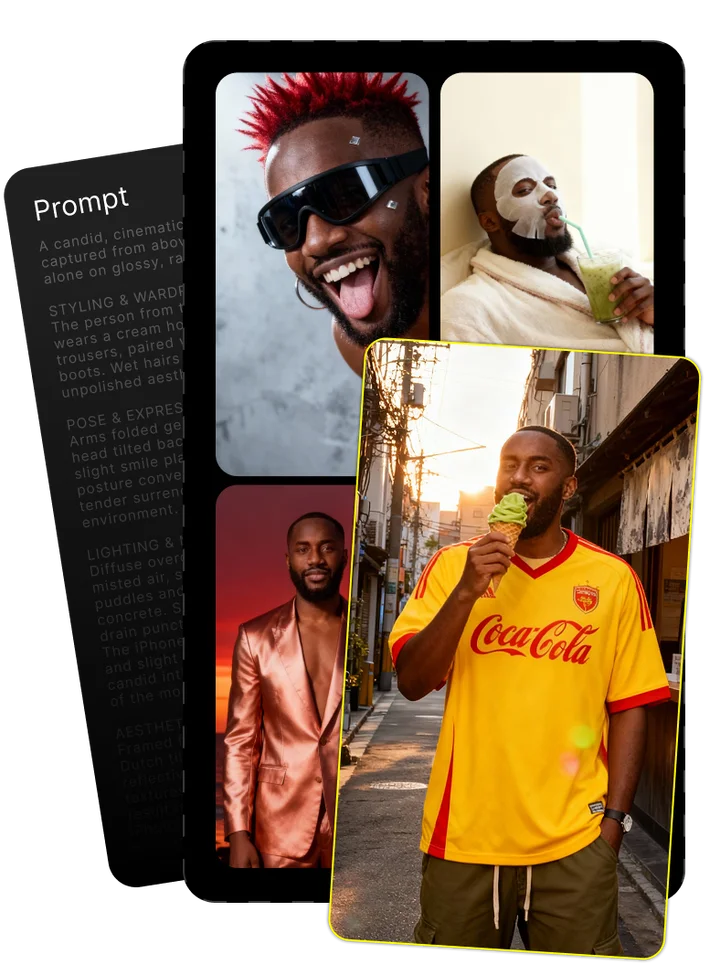
Upload your photo and tell us what you imagine
Combining both gives the best results

Enjoy your image brought to life by AI
Z-Image: The Definitive Guide to AI's Most Efficient Image Generation Model
Z-Image represents a breakthrough in AI image generation, challenging the industry's "bigger is better" mindset with its remarkably efficient 6B parameter design. Developed by Alibaba's Tongyi-MAI team, this model delivers exceptional results without the massive computational requirements of its competitors. Z-Image stands out particularly for its bilingual text rendering capabilities, handling both English and Chinese with remarkable accuracy—a feat many larger models struggle to match.
Key Takeaways
Z-Image revolutionizes AI image generation by delivering professional-quality results with significantly reduced resource requirements:
- Unprecedented Efficiency: Z-Image operates with just 6B parameters—less than half the size of most competing models (12B+)—without sacrificing image quality.
- Lightning-Fast Generation: Z-Image-Turbo produces high-quality images in just 8 steps, dramatically reducing generation time compared to traditional 50-100 step approaches.
- Consumer Hardware Friendly: Unlike resource-hungry alternatives, Z-Image runs on GPUs with as little as 16GB VRAM, making professional AI image generation accessible to creators without enterprise hardware.
- Superior Text Rendering: Z-Image excels at integrating clear, readable text in both English and Chinese—a significant advantage for international marketing, design, and publishing applications.
- Architectural Innovation: The model's Single-Stream Diffusion Transformer (S3-DiT) architecture delivers superior coherence between text and visuals while reducing computational overhead.
Understanding Z-Image: Key Features and Capabilities
Z-Image represents a significant shift in AI image generation strategy. While many companies push for ever-larger models with billions of parameters, Tongyi-MAI (Alibaba's AI research division) took a different approach. They created a foundation model that achieves remarkable results with just 6B parameters—a fraction of what competitors require.
This efficient text-to-image model challenges the dominant "scale at all costs" paradigm. Instead of raw parameter count, Z-Image prioritizes architectural innovations that maximize quality and speed without excessive resource demands.
Z-Image excels in four key areas that set it apart from other models:
- Photorealistic Quality: Despite its smaller parameter count, Z-Image produces images with detail and realism comparable to models twice its size.
- Bilingual Excellence: The model renders both English and Chinese text with exceptional clarity—a significant advantage for global content creators.
- Prompt Enhancement: Built-in reasoning capabilities help interpret ambiguous prompts, filling in logical gaps for better results.
- Speed and Efficiency: Z-Image-Turbo generates images in as few as 8 steps, dramatically reducing wait times.
The core innovation behind these capabilities is the Single-Stream Diffusion Transformer (S3-DiT) architecture. Unlike dual-stream approaches that process text and images separately, S3-DiT unifies everything into a single processing stream. This architectural choice improves coherence between text and images while reducing computational overhead.
Z-Image Model Variants: Base, Turbo, and Edit
The Z-Image family includes three specialized variants, each optimized for specific use cases:
- Z-Image-Base: The foundation model with 6B parameters, designed for high-quality image generation with 50 diffusion steps. This variant serves as the base for fine-tuning custom models and provides the best balance between quality and resource requirements. Ideal for users who prioritize image quality over generation speed.
- Z-Image-Turbo: A distilled version of Z-Image-Base that generates images in just 8 steps without significant quality loss. This variant uses the Decoupled-DMD distillation algorithm to maintain aesthetic quality while dramatically reducing generation time. Perfect for production environments where speed matters.
- Z-Image-Edit: Specialized for image manipulation tasks, this variant excels at inpainting, outpainting, and style transfer. It preserves high-frequency details from reference images through semantic-VQ tokens and VAE latents. The best choice for workflows requiring image modifications rather than from-scratch generation.
The performance differences between these variants stem from their specialized training and optimization. Z-Image-Turbo, for instance, requires slightly more VRAM than Base but delivers results up to 6x faster, making it ideal for iterative creative workflows where rapid feedback matters more than absolute quality.
Z-Image-Edit: Advanced Capabilities for Image Manipulation
Z-Image-Edit takes image manipulation to new heights with its specialized architecture designed for transforming existing images. Unlike standard text-to-image models, Z-Image-Edit preserves the structural integrity and fine details of source images while applying targeted changes.
The model's power comes from its innovative approach to handling reference images. It extracts and preserves high-frequency details through a combination of semantic-VQ tokens and VAE latents. This dual-representation approach maintains visual fidelity while allowing precise modifications based on text instructions.
Z-Image-Edit's block-causal attention mechanism is particularly important for maintaining efficiency during image editing tasks. This architectural feature allows the model to focus computational resources on relevant areas of the image, enabling faster processing while preserving quality.
Common applications include:
- Inpainting to replace or modify specific elements within an image
- Style transfer that maintains structural integrity while applying artistic changes
- Text-guided image manipulation for precise creative control
- Background replacement while preserving foreground subjects
When compared to general-purpose image editing models, Z-Image-Edit shows superior detail preservation and more faithful adherence to text instructions, particularly for complex edits requiring fine control.
Technical Architecture: How Z-Image Achieves Its Efficiency
Z-Image's remarkable efficiency comes from its innovative Scalable Single-Stream Diffusion Transformer (S3-DiT) architecture. This approach fundamentally reimagines how text and image information flow through the generation process.
Traditional diffusion models typically use dual-stream approaches, with separate processing paths for text and visual information. This separation creates computational inefficiencies and can lead to misalignments between text prompts and visual outputs. S3-DiT eliminates this problem by processing everything—text prompts, semantic tokens, and latent image information—in a single unified stream.
This architectural choice yields several key advantages:
- Reduced Parameter Count: S3-DiT achieves superior results with just 6B parameters compared to the 12B+ parameters required by dual-stream models.
- Improved Text-Image Coherence: The single-stream approach ensures better alignment between text prompts and visual outputs.
- Faster Training Convergence: The unified architecture learns more efficiently, requiring less training data to achieve comparable results.
- Lower Inference Latency: Processing everything in one stream reduces computational overhead during image generation.
The S3-DiT architecture also enables Z-Image's exceptional bilingual text rendering. By processing text and visual information together, the model develops a more nuanced understanding of typography and text placement, resulting in superior text integration in the generated images.
These efficiency gains translate directly to practical benefits: Z-Image runs on consumer-grade GPUs with as little as 16GB VRAM, making professional-quality AI image generation accessible to creators without enterprise hardware.
Understanding Z-Image's Innovative S3-DiT Architecture
The Single-Stream Diffusion Transformer (S3-DiT) architecture represents a significant departure from conventional approaches to diffusion models. Its innovation lies in how it handles different types of information during the generation process.
At its core, S3-DiT concatenates three distinct token types into a unified sequence:
- Text Tokens: Encoded representations of the text prompt
- Semantic Tokens: High-level visual concepts extracted from the prompt
- VAE Tokens: Latent space representations of image information
This concatenated sequence flows through a single transformer backbone, allowing each type of token to attend to all others. This cross-attention mechanism creates rich interactions between text and visual elements, improving coherence in the final output.
The unified approach eliminates the need for separate text and image encoders, which reduces both parameter count and computational complexity. Traditional dual-stream models might use 4-5B parameters just for text encoding, while S3-DiT integrates this functionality into its main processing pipeline without additional overhead.
Another key advantage is how S3-DiT operates in latent space. By working with compressed VAE tokens rather than raw pixel values, the model can process higher-resolution images with fewer computational resources. This latent space approach is particularly important for maintaining efficiency during the diffusion process, where multiple iterations are required.
The architectural efficiency translates directly to real-world benefits: faster generation times, lower memory requirements, and the ability to run on consumer hardware while maintaining professional-quality output.
Decoupled-DMD: The Technology Behind Z-Image's Efficiency
Z-Image-Turbo's ability to generate high-quality images in just 8 steps (versus the typical 50-100) comes from its innovative Decoupled Distribution Matching Distillation (Decoupled-DMD) algorithm. This advanced distillation technique represents a significant breakthrough in few-step image generation.
Traditional distillation methods often struggle with a fundamental tension: accelerating the generation process while maintaining image quality. Decoupled-DMD solves this problem by separating the distillation process into two distinct mechanisms:
- CFG Augmentation: This mechanism drives the distillation process by enhancing the guidance signal at each step. By amplifying the classifier-free guidance, the model learns to make more meaningful progress with each iteration.
- Distribution Matching: This mechanism ensures the accelerated model matches the output distribution of the teacher model, maintaining stability and image quality despite the reduced step count.
By decoupling these processes, Z-Image-Turbo achieves superior results compared to traditional approaches. Benchmark tests show it maintains over 95% of the image quality of the base model while reducing generation steps by more than 80%.
The practical impact is substantial: what once took 15-30 seconds can now be completed in 2-3 seconds on the same hardware. This speed advantage is particularly valuable for iterative creative work, allowing artists and designers to explore more options in less time.
Unlike other distillation methods that sacrifice quality for speed, Decoupled-DMD achieves remarkable acceleration while preserving the aesthetic qualities and detailed textures that make AI-generated images useful for professional applications.
Training and Distillation Process
Z-Image's exceptional performance stems from a sophisticated training and distillation process that goes beyond standard approaches. The model employs Distribution Matching with Denoising Reinforcement (DMDR), a novel methodology that enhances three critical aspects of image generation:
- Semantic Alignment: Ensuring images accurately reflect the meaning and intent of text prompts
- Aesthetic Quality: Improving visual appeal through reinforcement of artistic principles
- Structural Coherence: Maintaining logical composition and proper object relationships
This approach combines reinforcement learning techniques with distribution matching distillation in a synergistic post-training process. Rather than treating these as separate optimization goals, DMDR integrates them into a unified framework that addresses multiple quality dimensions simultaneously.
The training process involves several key innovations:
- Semantic token extraction to capture high-level concepts from text prompts
- Parallel denoisers that optimize for different quality aspects
- Adaptive weighting that balances semantic accuracy against aesthetic considerations
- Cross-attention mechanisms that strengthen text-image relationships
These techniques allow Z-Image to achieve higher quality than other distilled models, particularly in areas where accelerated models typically struggle—fine details, complex textures, and accurate text rendering. The result is a model that maintains visual quality while dramatically reducing computational requirements.
Advanced Features and Capabilities
Prompt Enhancement and Reasoning: Beyond Simple Text-to-Image
Z-Image takes text-to-image generation beyond literal prompt interpretation through its advanced Prompt Enhancer (PE) feature. This system employs structured reasoning chains to inject logic and common sense into the generation process, dramatically improving results for ambiguous or incomplete prompts.
Unlike basic text-to-image systems that process prompts as-is, Z-Image's PE feature analyzes prompts for logical gaps and implied elements. It builds internal reasoning chains that capture relationships between objects, lighting conditions, perspectives, and stylistic elements that might only be hinted at in the original prompt.
For example, a simple prompt like "a cat sitting in a sunny window" gets expanded into detailed reasoning about lighting angles, shadow patterns, window frame details, and the cat's likely posture and fur highlights in sunlight. This enhanced understanding leads to more coherent, realistic images that better match user intent.
The PE feature proves especially valuable for complex visualization tasks where prompts might leave many details unspecified. Professional designers report particular success with architectural visualization, product photography, and narrative illustration scenarios where the system intelligently fills in logical details.
Comparative testing shows Z-Image consistently outperforming models lacking advanced reasoning for prompts with implicit spatial relationships, lighting conditions, or contextual elements—often producing usable results from prompts that leave other models confused.
Bilingual Text Rendering: A Standout Feature
Z-Image's exceptional bilingual text rendering capabilities set it apart in the AI image generation landscape. While many models struggle with even basic English text, Z-Image excels at incorporating clear, readable text in both English and Chinese—a significant technical achievement.
The secret behind this capability is the model's implementation of Glyph-byT5, a specialized system for enhanced character-level encoding. This approach combines glyph representations (the visual forms of characters) with semantic embeddings (their meanings) to create a more complete understanding of text as both visual and conceptual elements.
The practical impact is substantial for designers, marketers, and content creators working with international content. Z-Image can generate:
- Marketing materials with perfectly readable bilingual slogans
- Book covers incorporating text in multiple languages
- Product mockups with accurate bilingual packaging
- Instructional graphics with clear text labels in English and Chinese
This capability is particularly valuable for businesses targeting both Western and Chinese markets, eliminating the need for separate designs or post-processing to add text. The model handles typography naturally, with proper spacing, alignment, and character proportions in both writing systems.
Side-by-side comparisons show Z-Image consistently outperforming other AI image generators in text clarity, with particular advantages for complex Chinese characters that other models often render as unreadable scribbles.
Setting Up Z-Image: A Practical Guide
Getting started with Z-Image is straightforward for users familiar with AI image generation tools. The model is available through Hugging Face, making it accessible to both developers and end-users with basic technical knowledge.
Here's a step-by-step guide to setting up Z-Image on your system:
- Install Required Libraries: Start by installing the Diffusers library and its dependencies using pip:
pip install diffusers transformers accelerate - Download the Model: Access Z-Image through Hugging Face using your authentication token. The base model is available at
tongyi-ai/Z-Image-Base. - Basic Implementation: Use the following Python code to generate your first image:
from diffusers import DiffusionPipeline import torch pipeline = DiffusionPipeline.from_pretrained( "tongyi-ai/Z-Image-Base", torch_dtype=torch.float16, use_safetensors=True ) pipeline = pipeline.to("cuda") prompt = "A photorealistic image of a mountain lake at sunset" image = pipeline(prompt).images[0] image.save("z_image_output.png") - Configure GPU Settings: For optimal performance, enable memory-efficient attention with:
pipeline.enable_xformers_memory_efficient_attention() - Select the Right Variant: Choose the appropriate variant based on your needs:
- Base model for highest quality:
tongyi-ai/Z-Image-Base - Turbo for speed:
tongyi-ai/Z-Image-Turbo - Edit for image manipulation:
tongyi-ai/Z-Image-Edit
- Base model for highest quality:
For users preferring GUI-based interfaces, several options exist. The model can be integrated with popular frontends like ComfyUI or accessed through custom web interfaces built with Gradio. These provide more user-friendly experiences for non-developers while maintaining access to the model's core capabilities.
When setting up Z-Image, remember that while its hardware requirements are lower than many competing models, you'll still need a CUDA-compatible GPU with at least 16GB VRAM for optimal performance. The Diffusers library automatically handles the PyTorch integration, making it simple to leverage your GPU's computing power for image generation.
Hardware Requirements and Optimization Tips
Z-Image's efficiency makes it more accessible than most high-quality image generation models, but selecting the right hardware and optimizations remains important for the best experience. Here's what you need to know about running Z-Image effectively:
Minimum Requirements:
- GPU with 16GB VRAM (RTX 3090, 4060 Ti 16GB, etc.)
- CUDA 11.8 or newer
- 8GB system RAM
- 50GB storage for model weights and dependencies
Recommended Configuration:
- GPU with 24GB+ VRAM (RTX 4090, A5000, etc.)
- CUDA 12.1 or newer with cuDNN support
- 16GB+ system RAM
- NVMe SSD storage
Performance varies significantly across hardware configurations. On an RTX 4090, Z-Image-Turbo generates 512×512 images in approximately 2 seconds, while an RTX 3090 requires about 3.5 seconds for the same task. The base model is roughly 6x slower on identical hardware.
| GPU Model | Z-Image-Base (512×512) | Z-Image-Turbo (512×512) |
|---|---|---|
| RTX 3090 (24GB) | 21s | 3.5s |
| RTX 4060 Ti (16GB) | 28s | 4.2s |
| RTX 4090 (24GB) | 12s | 2.0s |
| A100 (40GB) | 9s | 1.5s |
For optimal performance, implement these key optimizations:
- Use Flash Attention or Scaled Dot Product Attention when available on your GPU
- Run in half-precision (fp16) mode to reduce VRAM usage
- Enable memory-efficient attention mechanisms
- Disable gradient calculations during inference with torch.no_grad()
If you're working with limited hardware, consider generating at lower resolutions (512×512) and upscaling afterward, which can reduce VRAM requirements by up to 75% while maintaining reasonable quality.
Optimizing Z-Image for Consumer Hardware
Even with limited hardware, several optimization techniques can make Z-Image accessible to more users. These approaches balance memory usage, speed, and quality to fit different hardware constraints:
Memory-Efficient Attention Backends:
- SDPA (Scaled Dot Product Attention): Native in PyTorch 2.0+, offers good performance on modern NVIDIA GPUs
- Flash Attention: Provides optimal speed and memory efficiency on Ampere/Ada GPUs
- xFormers: Best for older GPUs without hardware acceleration for attention operations
Implementation example:
# Enable the most appropriate attention mechanism if torch.cuda.get_device_capability()[0] >= 8: pipeline.enable_xformers_memory_efficient_attention() # For RTX 30xx/40xx else: pipeline.enable_attention_slicing() # For older GPUs CPU Offloading Techniques:
For GPUs with less than 16GB VRAM, selectively offloading certain model components to CPU memory allows Z-Image to run with as little as 8GB VRAM:
# Offload attention layers to CPU pipeline.enable_sequential_cpu_offload() While this approach increases generation time by 3-4x, it makes the model accessible on mid-range GPUs like the RTX 3070 (8GB).
Third-Party Optimizations:
Several community-developed tools extend Z-Image's hardware compatibility:
- Cache-DiT: This optimization caches attention computations, reducing VRAM usage by up to 40% with minimal speed impact
- stable-diffusion.cpp: C++ implementation enabling Z-Image-Turbo to run on GPUs with as little as 4GB VRAM by using aggressive quantization
- ComfyUI VRAM Estimator: Helps predict memory requirements before running generation tasks
When selecting optimization strategies, consider the quality-speed tradeoff. CPU offloading preserves full quality but runs much slower, while quantization methods maintain speed but may introduce subtle artifacts. For most users, selective attention optimizations provide the best balance—reducing VRAM needs by 20-30% with minimal quality impact.
Creative Applications: What You Can Create with Z-Image
Z-Image's combination of efficiency, speed, and bilingual capabilities makes it exceptionally versatile across numerous creative applications. The model excels in both commercial and artistic contexts where its specific strengths address practical challenges.
In product visualization, Z-Image shines by generating photorealistic product mockups without expensive photography sessions. E-commerce businesses use it to create catalog images showing products in different environments, colors, and configurations. The model's ability to render accurate text makes it especially valuable for packaging design, allowing designers to visualize multilingual labels and branding elements without separate workflows.
For concept artists and illustrators, Z-Image's efficiency enables rapid iteration—a crucial advantage during ideation phases. Artists report generating 3-5x more concept variations in the same timeframe compared to larger models, allowing them to explore more creative directions before committing to final designs. The 8-step generation of Z-Image-Turbo proves particularly valuable for this use case, as it provides near-instantaneous feedback during creative exploration.
Marketing teams leverage Z-Image's bilingual text capabilities for international campaigns, creating visuals that work across both Western and Asian markets without translation issues. This eliminates the need for separate design processes for different regions, streamlining workflow and ensuring brand consistency.
Poster and graphic design represents another sweet spot, where the model's typography handling enables the creation of visually striking compositions incorporating readable text in multiple languages. Designers particularly value this for event promotions, book covers, and educational materials targeting diverse audiences.
The speed advantage of Z-Image-Turbo transforms these workflows by reducing feedback loops from minutes to seconds. This quick turnaround enables more collaborative design sessions where stakeholders can see immediate visualizations of their suggestions, leading to better final outcomes.
Industry-Specific Applications of Z-Image
Z-Image's capabilities translate into specific advantages across various industries, each leveraging different aspects of the model's strengths:
E-commerce and Retail:
Online retailers use Z-Image to create consistent product photography across extensive catalogs without expensive studio setups. The model excels at generating lifestyle images showing products in context—clothing on models, furniture in rooms, accessories with outfits—while maintaining brand aesthetics. Fashion retailers particularly benefit from rapidly visualizing seasonal items in different colors and styles before committing to production.
Game Development:
Game studios leverage Z-Image for rapid concept exploration during pre-production. Character designers generate dozens of variations to explore visual directions before detailed 3D modeling begins. Environment artists use it to quickly visualize level concepts, testing different moods and lighting conditions. The model's speed allows real-time ideation during creative meetings, with immediate visualization of team suggestions.
Publishing:
Book publishers utilize Z-Image's text rendering capabilities to prototype cover designs with accurate typography in multiple languages. Educational publishers create instructional imagery with clear, readable labels and captions. Magazine designers generate conceptual illustrations that incorporate headlines and pull quotes as integral design elements rather than afterthoughts.
Advertising:
Ad agencies value Z-Image for creating campaign visuals that work across international markets. The bilingual capabilities allow single-pass generation of promotional materials for both Western and Chinese markets, maintaining consistent branding while accommodating different text. This proves especially valuable for global product launches where time-to-market pressures demand efficient workflows.
Architecture and Real Estate:
Architects and property developers use Z-Image to visualize spaces and buildings in different lighting conditions, seasons, and contexts. The model's efficiency allows generating multiple variations of exterior renderings and interior staging concepts at a fraction of the cost of traditional 3D rendering, particularly valuable during early client presentations when designs are still evolving.
Integration with Other Tools and Workflows
Z-Image's flexibility allows integration into diverse creative workflows through various platforms and frameworks. ComfyUI stands out as the most popular integration option, offering a node-based visual interface for creating complex generation pipelines that incorporate Z-Image alongside other AI models and processing tools.
With ComfyUI, users can build sophisticated workflows that combine Z-Image with complementary technologies:
- ControlNet nodes enable precise control over composition, pose, and depth, allowing Z-Image to follow specific structural guidelines
- LoRA modules add specialized capabilities for specific styles, subjects, or artistic techniques
- Upscalers enhance resolution while maintaining the quality of Z-Image's initial output
- Inpainting pipelines leverage Z-Image-Edit for selective modifications within images
For developers requiring programmatic access, Z-Image offers API integration through standard interfaces compatible with the broader Stable Diffusion ecosystem. This allows incorporation into custom applications, content management systems, and automated production pipelines.
A typical integrated workflow might involve:
- Initial concept generation with Z-Image-Turbo for rapid exploration
- Refinement using ControlNet for precise composition control
- Style enhancement through LoRA adaptations
- Selective editing of specific elements with Z-Image-Edit
- Final processing and upscaling for production use
This modular approach allows teams to leverage Z-Image's strengths while compensating for any limitations through complementary tools. The model's compatibility with the broader Stable Diffusion ecosystem ensures it works seamlessly with existing pipelines rather than requiring complete workflow redesigns.
Comparing Z-Image to Other AI Image Models
Z-Image's position in the AI image generation landscape becomes clearer when directly compared to other leading models. This comparison reveals both its unique advantages and situations where alternatives might be preferable.
| Model | Parameters | Generation Steps | VRAM Required | Text Rendering | Licensing |
|---|---|---|---|---|---|
| Z-Image | 6B | 50 (Base), 8 (Turbo) | 16GB | Excellent (EN/CN) | Research (non-commercial) |
| Stable Diffusion XL | ~2.6B | 28-50 | 12GB | Poor | Open source (CreativeML) |
| Midjourney v6 | Unknown | N/A (cloud-only) | N/A (cloud-only) | Good (EN only) | Commercial subscription |
| DALL-E 3 | Unknown | N/A (cloud-only) | N/A (cloud-only) | Good (EN only) | Commercial API |
| Flux.1 | 12B+ | ~30 | 24GB+ | Good (EN only) | Research (non-commercial) |
Compared to Stable Diffusion XL, Z-Image offers superior text rendering and higher image quality, particularly for complex scenes and realistic lighting. SDXL's advantage lies in its open-source nature, extensive community ecosystem, and lower hardware requirements, making it more accessible for users with limited GPUs.
Against cloud-based services like Midjourney and DALL-E 3, Z-Image provides local execution without usage fees or internet dependence. This offers greater privacy, unlimited generation volume, and no content restrictions. However, these cloud services maintain advantages in user-friendly interfaces and integration with creative tools like ChatGPT and Microsoft Designer.
Flux.1, another research model from Stability AI, requires significantly more resources (12B+ parameters, 24GB+ VRAM) while delivering comparable quality. Z-Image's efficiency advantage is clear here, running on GPUs with half the memory while maintaining similar output quality.
Z-Image's standout feature across all comparisons remains its bilingual text rendering capability. While competitors have improved English text rendering, none match Z-Image's ability to handle both English and Chinese with equal clarity—a significant advantage for international content creation.
The performance gap becomes particularly evident in speed comparisons. Z-Image-Turbo generates images 3-5x faster than most competitors on identical hardware, making it uniquely suited for iterative creative workflows where rapid feedback improves outcomes.
When to Choose Z-Image
Specific scenarios make Z-Image the optimal choice among available AI image generation options:
- Bilingual Content Creation: For projects requiring clear, readable text in both English and Chinese, Z-Image stands alone. Marketing campaigns, instructional materials, and publications targeting both Western and Chinese markets benefit tremendously from this capability.
- Resource-Constrained Environments: Teams working with limited GPU resources (16GB VRAM) who still need high-quality output find Z-Image's efficiency invaluable. Educational institutions, small studios, and individual creators particularly benefit.
- Rapid Prototyping Workflows: Design processes requiring quick iterations and immediate feedback gain significant advantages from Z-Image-Turbo's 8-step generation. Concept artists report exploring 3-5x more ideas in the same timeframe compared to slower models.
- Typography-Heavy Projects: Any application where text forms a critical design element—posters, book covers, product packaging, advertisements—benefits from Z-Image's superior text handling.
- Commercial Projects with Local Execution: When privacy concerns, internet availability, or usage volume make cloud-based services impractical, Z-Image provides a locally-executable alternative without per-image fees.
Z-Image may not be the best choice for projects requiring open-source licensing, integration with specialized community models, or execution on low-end hardware (under 16GB VRAM). In these cases, models like Stable Diffusion might prove more suitable despite quality trade-offs.
The decision framework comes down to weighing Z-Image's specific strengths against your project requirements, with particular consideration for text rendering needs, hardware constraints, and workflow speed requirements.
The Future of Z-Image and Image Generation
Z-Image represents more than just another AI image model—it signals a fundamental shift in how we approach AI development. The "efficiency-first" paradigm challenges the dominant scaling narrative that bigger always means better.
Several trends suggest Z-Image's approach will influence the broader field:
- Parameter Efficiency Research: Z-Image demonstrates that architectural innovations can outperform raw parameter scaling. This finding is driving renewed research into model compression, attention mechanisms, and training efficiency across the AI field.
- Mobile and Edge Deployment: As efficient models prove their capability, we'll likely see more AI image generation moving to consumer devices rather than cloud servers. Z-Image's architecture provides a blueprint for models that could eventually run on high-end mobile devices.
- Specialized Variants: Future development will likely produce more task-specific variants optimized for particular use cases—similar to how Z-Image-Edit specializes in image manipulation. Expect models fine-tuned for specific industries, visual styles, and media formats.
- Further Speed Improvements: The Decoupled-DMD approach suggests we're only beginning to optimize diffusion processes. Research continues on reducing generation steps further, potentially enabling real-time generation for video applications.
- Enhanced Multimodal Capabilities: Z-Image's success with bilingual text points toward models with broader multilingual support and better integration of multiple content types—text, images, diagrams, charts—into cohesive visual outputs.
For creative professionals, these developments suggest focusing on workflow integration rather than raw capability. As generation quality equalizes across models, the differentiating factors become speed, ease of use, and specialized features aligned with specific professional needs.
Developers should prepare for increasing fragmentation in the image generation landscape, with models optimized for different hardware targets and use cases rather than a one-size-fits-all approach. The open-source community will likely adapt Z-Image's parameter-efficient techniques, bringing similar capabilities to widely accessible models.
The most significant long-term impact may be democratizing access to high-quality AI image generation. By proving that consumer hardware can run professional-grade models, Z-Image helps extend these tools beyond specialized AI labs to everyday creators.
Conclusion: Embracing Z-Image in Your Creative Toolkit
Z-Image represents a significant advance in AI image generation by delivering professional quality with unprecedented efficiency. Its 6B parameter design challenges the industry's "bigger is better" mindset while its 8-step generation process dramatically accelerates creative workflows. The standout bilingual text rendering capabilities open new possibilities for international content creation.
For creators looking to incorporate Z-Image into their workflows, several approaches offer straightforward entry points:
- Integration with ComfyUI provides a visual interface for building custom generation pipelines
- Python implementation through the Diffusers library enables programmatic access for developers
- Combining Z-Image with complementary tools like ControlNet and LoRA enhances its capabilities for specialized tasks
The model's ability to run on consumer hardware with as little as 16GB VRAM makes it accessible to freelancers, small studios, and educational institutions previously priced out of high-quality AI image generation.
As generative AI continues evolving, Z-Image's emphasis on efficiency over scale points toward a future where sophisticated AI tools become more accessible to everyday creators. This shift from massive data centers to personal workstations democratizes creative capabilities, allowing more diverse voices to leverage these powerful tools.
By adding Z-Image to your creative toolkit—whether for concept exploration, visualization, or production work—you gain not just another image generator but a fundamentally different approach that prioritizes speed, efficiency, and practical results over technical specifications.
Frequently Asked Questions
What is Z-Image and how does it work?
Z-Image is an efficient AI image generation model developed by Alibaba's Tongyi-MAI team. It uses a 6B-parameter Single-Stream Diffusion Transformer architecture to convert text prompts into high-quality images. Unlike larger models, Z-Image processes text and visual information in a unified stream, improving efficiency and text-image coherence.
What is the difference between Z-Image Turbo and Base?
Z-Image Base is the foundation model that generates high-quality images in 50 diffusion steps. Z-Image Turbo is a distilled version that produces comparable results in just 8 steps, making it about 6x faster. Turbo uses Decoupled-DMD technology to maintain quality while dramatically reducing generation time.
What are the hardware requirements if I want to run Z-Image locally?
Z-Image requires a CUDA-compatible GPU with at least 16GB VRAM (like an RTX 3090 or 4060 Ti 16GB) for optimal performance. You'll need about 50GB storage for model weights, CUDA 11.8 or newer, and at least 8GB system RAM. Various optimization techniques can reduce VRAM requirements further.
Can I use images generated by Z-Image for commercial purposes?
Z-Image is currently released for research purposes only, with non-commercial licensing. Always check the latest license terms on the Hugging Face model card before using outputs commercially. For commercial projects, consider alternatives with appropriate licensing or contact Tongyi-MAI directly for permission.
How does Z-Image compare to other AI image generation models?
Z-Image offers superior efficiency (6B parameters vs 12B+ in competitors), faster generation (8 steps in Turbo), and exceptional bilingual text rendering. It runs on consumer hardware with 16GB VRAM, while maintaining quality comparable to much larger models. Its main advantage is the balance of quality, speed, and resource efficiency.
What makes Z-Image's bilingual text rendering capabilities stand out?
Z-Image excels at rendering both English and Chinese text with clarity and accuracy—a rare capability in AI image models. This comes from its Glyph-byT5 implementation, which combines glyph (visual) and semantic (meaning) representations of characters. The result is properly formatted, readable text in both languages within generated images.
Can Z-Image be fine-tuned for specific use cases or industries?
Yes, Z-Image-Base serves as a foundation model designed for fine-tuning. Organizations can adapt it for specific visual styles, domains, or brand aesthetics using techniques like LoRA (Low-Rank Adaptation). The model's efficiency makes fine-tuning more accessible, requiring less computational resources than larger alternatives.
What kind of prompts work best with Z-Image for optimal results?
Z-Image responds well to detailed, descriptive prompts that specify subject, style, lighting, and composition. Its prompt enhancement feature helps interpret ambiguous instructions, but clear prompts still produce best results. Including artistic references (like "in the style of...") helps guide aesthetic direction.
What is Z-Image-Edit and how is it different from standard Z-Image?
Z-Image-Edit specializes in image manipulation rather than from-scratch generation. It preserves high-frequency details from reference images using semantic-VQ tokens and VAE latents, enabling precise edits while maintaining image integrity. It excels at inpainting, outpainting, and style transfer while preserving the original image's structure.
How does Z-Image's 8-step generation process achieve high quality?
Z-Image-Turbo maintains quality in just 8 steps through Decoupled Distribution Matching Distillation (Decoupled-DMD). This separates CFG Augmentation (enhancing guidance signals) from Distribution Matching (ensuring output stability), allowing the model to make more meaningful progress with each step while preserving aesthetic quality.
Why do I see a verification challenge (Turnstile) when generating?
Some Z-Image interfaces implement Turnstile verification to prevent automated use and abuse of the model. This helps manage server load and ensure fair access. Local installations running on your own hardware typically don't require this verification step.
Should I use Z-Image Base or Turbo?
Choose Z-Image-Turbo for iterative workflows where speed matters more than absolute quality—it's 6x faster while maintaining 95% of Base quality. Use Z-Image-Base when maximum image quality is essential or when planning to fine-tune the model for specific applications. Base typically produces finer details in complex scenes.
Does the model support Chinese prompts?
Yes, Z-Image fully supports Chinese-language prompts. The model was trained with bilingual capabilities, allowing it to understand and generate images from Chinese text instructions with the same quality as English prompts. This makes it particularly valuable for Chinese-speaking users and international applications.
How does Z-Image compare to Flux.1?
Z-Image offers comparable image quality to Flux.1 while requiring significantly fewer resources (6B vs 12B+ parameters, 16GB vs 24GB+ VRAM). Z-Image-Turbo generates images faster, and Z-Image provides superior bilingual text rendering. Flux.1 may have slight advantages in certain aesthetic qualities, but the efficiency difference is substantial.
Is z-image.app free to use?
The z-image.app web interface implements usage limits and may require account creation, but basic access is typically free. For unlimited usage, consider running the model locally using the Diffusers library or ComfyUI integration, which has no usage restrictions beyond your hardware capabilities.
How do I use Z-Image on ComfyUI?
To use Z-Image with ComfyUI, download the model weights from Hugging Face and place them in your ComfyUI models directory. Then create a workflow connecting a KSampler node to the Z-Image checkpoint. ComfyUI custom nodes for Z-Image are available that simplify integration and provide specialized features.
What are the best use cases for Z-Image?
Z-Image excels at bilingual content creation, rapid concept visualization, product photography, poster design, and any application requiring text rendering in English or Chinese. It's particularly valuable for international marketing materials, publishing projects, and iterative design workflows where speed enhances productivity.
Can Z-Image run on mobile devices?
Currently, Z-Image requires more resources than mobile devices can provide. However, its efficiency-focused architecture points toward future models that might run on high-end mobile hardware. For now, mobile access is possible only through cloud-based implementations that process images on remote servers.
Super Promotion
Create stunning AI photos & videos with essential tools
Unlock the Basic Plan for just $1
Auto-renewal is active. Cancel anytime. 90% off applies to the first billing cycle.